

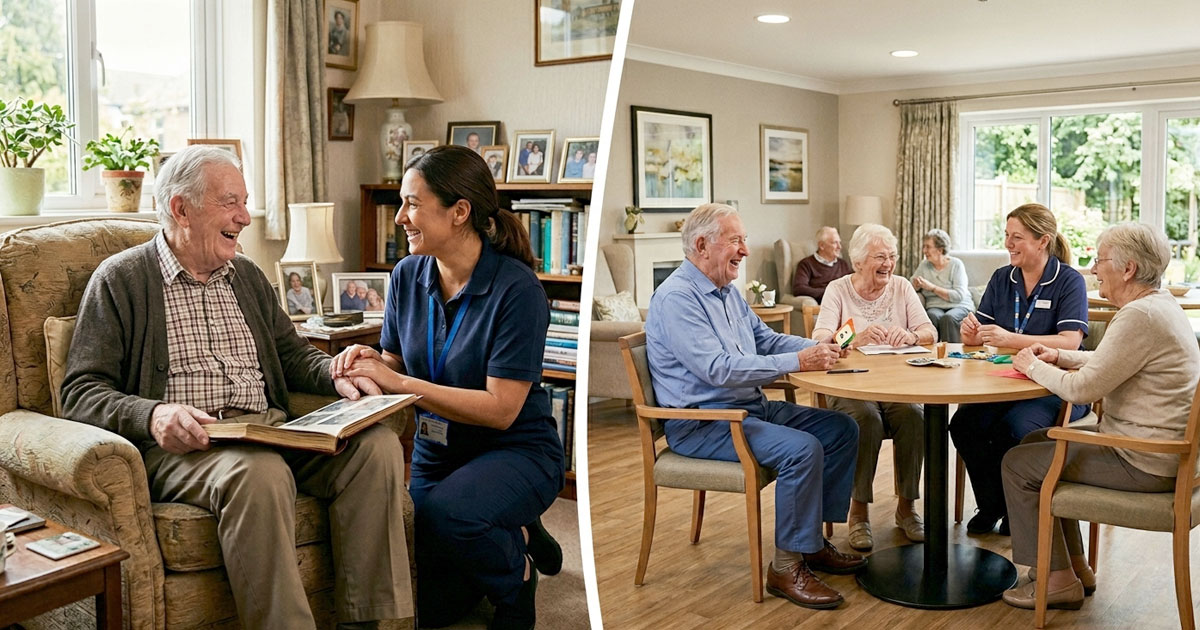
When an older parent or family member begins to need more support, one of the most significant decisions a family faces is whether to arrange care at home or consider a move to a residential care home. It is rarely a straightforward choice, and the right answer depends on the individual's needs, wishes, home environment, and the level of support that family members can provide.
This guide sets out the key differences between home care (domiciliary care) and residential care homes, compares costs, considers quality of life, and provides a practical framework to help families in Richmond, Hounslow, and across London make an informed decision.
What Is the Difference Between Home Care and a Care Home?
Home Care (Domiciliary Care)
Home care means professional support is provided in the person's own home. A care worker visits at scheduled times — or lives in the home — to assist with personal care, medication, meals, household tasks, and companionship. The person continues to live in their own home, in their own community, surrounded by familiar people and belongings.
Residential Care Home
A residential care home provides accommodation, meals, and personal care on a permanent or long-term basis. The person moves out of their own home and into the care home, where they share communal spaces with other residents and receive care from staff on duty. Nursing homes are a type of care home that also provides registered nursing care on site.
Side-by-Side Comparison: Home Care vs Care Home
| Factor | Home Care | Care Home |
|---|---|---|
| Living environment | Own home | Communal residential facility |
| Independence | High — routines and preferences maintained | More structured; routines set by the home |
| Cost (moderate needs) | Generally lower for hourly visits | Higher weekly cost (includes accommodation) |
| Cost (complex needs) | Can be comparable to care home if many hours needed | Fixed weekly fee regardless of care level |
| Personalisation | High — fully tailored care plan | Less individual; shared staffing |
| Continuity of carer | Usually same carers each visit | Rotating staff shifts |
| Safety | Depends on home environment and care package | 24/7 staff presence; purpose-built environment |
| Social interaction | With carers, family, and community | With other residents and staff |
| Suitability for dementia | Good for mild to moderate stages | Specialist dementia care homes available for later stages |
| Family involvement | Easier; family can visit freely and help with care | Visiting hours may apply; less hands-on involvement |
Quality of Life: The Case for Remaining at Home
For the vast majority of older adults, remaining in their own home is their preferred option. Home is associated with identity, security, and independence — all of which are fundamental to wellbeing, particularly as people age.
Research consistently shows that older people living at home with appropriate support report higher levels of life satisfaction and autonomy than those in residential care. Familiar surroundings, personal possessions, the ability to eat what you want when you want, to get up and go to bed at times of your choosing, and to have your pets nearby — these things matter profoundly.
For people living with dementia, familiar environments are especially important. Remaining at home in a known setting can reduce confusion and distress, and a skilled domiciliary care worker trained in dementia care can support daily living while reinforcing routines that provide comfort and orientation.
When a Care Home May Be the Right Choice
Home care is not the right answer for everyone. There are circumstances where a residential care home genuinely offers the safest, most appropriate care. These include:
- Very high or complex care needs that cannot be safely met at home, even with intensive domiciliary care — for example, someone who requires continuous nursing supervision
- Advanced dementia with significant behavioural challenges, where specialist dementia care facilities provide structured environments specifically designed for that stage
- An unsafe home environment that cannot practically be adapted (e.g. multi-storey homes with no ground-floor facilities, no family nearby, and high fall risk)
- Severe isolation or loneliness where the person would benefit from the social community of a care home
- Carer breakdown where a family carer's health or capacity means they can no longer support the person at home, even with professional care input
- End-of-life care needs that require round-the-clock clinical support beyond what can be provided at home (though many people do successfully receive end-of-life care at home)
Cost Comparison: Home Care vs Care Home in London
Cost is often a significant factor in this decision, particularly for families who are self-funding. It is important to compare like-for-like.
Care Home Costs in London (2024–25)
The average weekly cost of a residential care home place in London is typically in the range of £1,000–£1,500 per week, though this varies considerably by location, the level of care provided, and the type of room. Nursing home placements are usually more expensive.
Home Care Costs in London (2024–25)
For someone who needs, say, two visits per day of one hour each at £22 per hour, the cost would be approximately £308 per week — considerably less than a care home. However, if needs escalate to require six to eight hours of care per day, costs could rise to £850–£1,250 per week, making home care and care home costs increasingly comparable.
Live-in care — where a carer lives in the home and provides support throughout the day — typically costs between £900 and £1,400 per week in London, again depending on the level of care needed.
It is also worth noting that care home fees include accommodation and food, whereas with home care the person continues to meet their own accommodation, bills, and food costs.
Involving Your Loved One in the Decision
Wherever possible, the person who needs care should be at the centre of this decision. Under the Care Act 2014, local authorities have a legal duty to promote wellbeing and to ensure that individuals are involved in decisions about their care.
Even where cognitive decline makes some discussions more complex, it is important to listen to the person's expressed preferences, observe their emotional responses to different settings, and work with professionals such as social workers and GPs who can help facilitate decision-making with capacity in mind.
If the person has previously expressed a strong wish to remain at home — perhaps in an advance statement or through conversations with family — this should carry significant weight, even if they can no longer communicate it clearly.
A Stepped Approach: Starting with Home Care
For many families, the right approach is to begin with home care and review as needs change. Home care can often be increased and adapted over time without requiring a move into residential care. A good domiciliary care provider will work with you to review care plans regularly and flag when needs are approaching the threshold where a different type of care might be more appropriate.
This stepped approach preserves the person's home life for as long as possible and avoids premature moves into care homes, while still ensuring that a transition can be made smoothly if the time comes.
Dementia Care at Home in Richmond and London
Dementia and Alzheimer's care at home is one of the most in-demand areas of domiciliary care across Richmond, Hounslow, and wider London. Kindlio's care team includes workers with specialist dementia training who understand the unique challenges of supporting someone through cognitive decline at home.
From consistent routines and familiar faces to carefully managed medication and nutrition support, expert home-based dementia care can make a transformative difference — enabling people to live well at home for longer, and giving families confidence and peace of mind.
If your loved one has received a dementia diagnosis and you are weighing up home care versus a residential placement, our team is happy to discuss options and help you think through the right path for your family.
Frequently Asked Questions: Home Care vs Care Home
-
Is home care better than a care home?For many people, home care is preferable because it allows them to remain in familiar surroundings, maintain independence, and keep their daily routines. Research suggests that remaining at home can have positive effects on mental wellbeing, particularly for people with dementia. However, a care home may be more suitable if someone's needs are very complex, if the home cannot be made safe, or if round-the-clock nursing care is required.
-
Is home care cheaper than a care home?For lower or moderate levels of need, home care is generally less expensive than a residential care home placement. However, if very high levels of home care are needed, the costs can become comparable. Live-in home care can also be similar in cost to a care home. Compare total costs based on your specific situation.
-
Can someone with dementia stay at home with home care?Yes. Many people with dementia remain at home with domiciliary care for many years. Home care workers trained in dementia care provide personal care, medication support, companionship, and routine support. As needs increase, the care package can be reviewed and increased accordingly.
-
What are the disadvantages of a care home?Moving into a care home can involve loss of independence, separation from a familiar environment, and reduced ability to maintain personal routines. Care homes vary in quality. The communal environment may not suit everyone, and costs are significant — often over £1,000 per week in London.
-
How do I know if my parent needs a care home or home care?The right choice depends on assessed care needs, home environment safety, your parent's wishes, and available family support. A care needs assessment from the local authority is the best starting point. For many older people with moderate needs, home care is a viable and preferred option. A care home may be more appropriate for complex clinical needs or where the home cannot be made safe.
Explore Home Care Options in Richmond and London
Kindlio is a CQC-registered domiciliary care provider based in Hounslow, supporting families across Richmond and London with personal care, dementia care, live-in care, and more. If you are weighing up the options for a loved one, we are here to help you think it through.